


Having done one tour with a photographer guide and one without, I definitely recommend the photographic tour. First, because Tui de Roy was fantastic—she moved to Galapagos at the age of two and spent most of her life exploring, playing, understanding, and photographing the islands. Her multiple books establish her as the premier Galapagos photographer. It's like taking a tour of Yosemite with Ansel Adams. Furthermore, she is very willing, capable, and friendly in sharing her knowledge with you. And second, because you just see more on a photographic tour. With the naturalist-only tour, suppose you see a lone marine iguana for the first time. The naturalist gives a one-minute description, the group stands around and looks for another minute, then it is time to move on. With a photographic tour, you spend ten minutes as each photographer explores different angles, and in those ten minutes (versus two) you have a much better chance that the animal will actually do something interesting. Overall you spend at least an hour longer in each landing with the photographic tour.
We were on the 16-passenger Tip Top IV. My friend Corey went on The Beagle, a similarly-sized sailboat (which mostly travels by motor) and got a great set of photos himself. A sailboat is much cooler, but the Tip Top IV has the speed advantage, 12 knots to 9, which means I spent less time in potentially seasickness-inducing open waters. There are larger ships but I would recommend against them, because the landings would be too crowded.
Here's our ship, a room, and a panga:


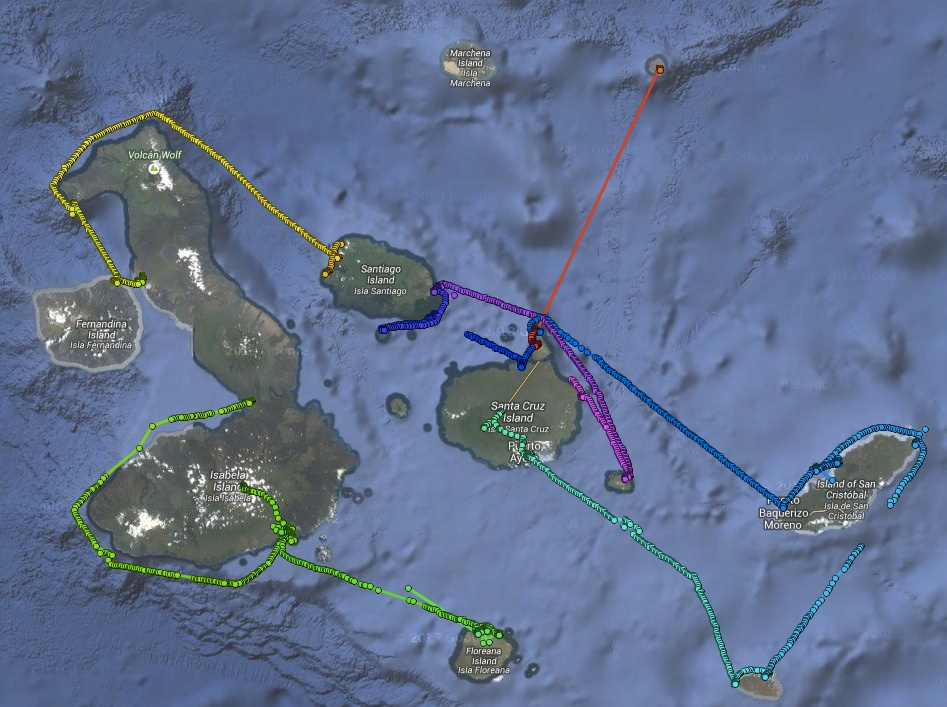
North Seymour: Best colonies of frigate birds and blue-footed boobies. Marine and land iguanas; sea lions, sally lightfoot crabs.
South Plaza: Land iguanas, scenic landscapes, a cliff from which you can catch tropic birds, gulls, boobies, and other birds flying below.
Espanola: Your only chance to see albatross.
Santa Cruz: Black turtle cove is your best chance to see diving pelicans and boobies.
Santiago: Best collection of marine iguanas on lava (often with Sally lightfoot crabs); best
ghost crabs on sand; sea lions and sea turtles; landscape.
Tower (or Genovesa): Best chance for red-footed boobies; frigate and other birds.
Fernandina: Marine iguanas, lava, landscape, lava cactus.
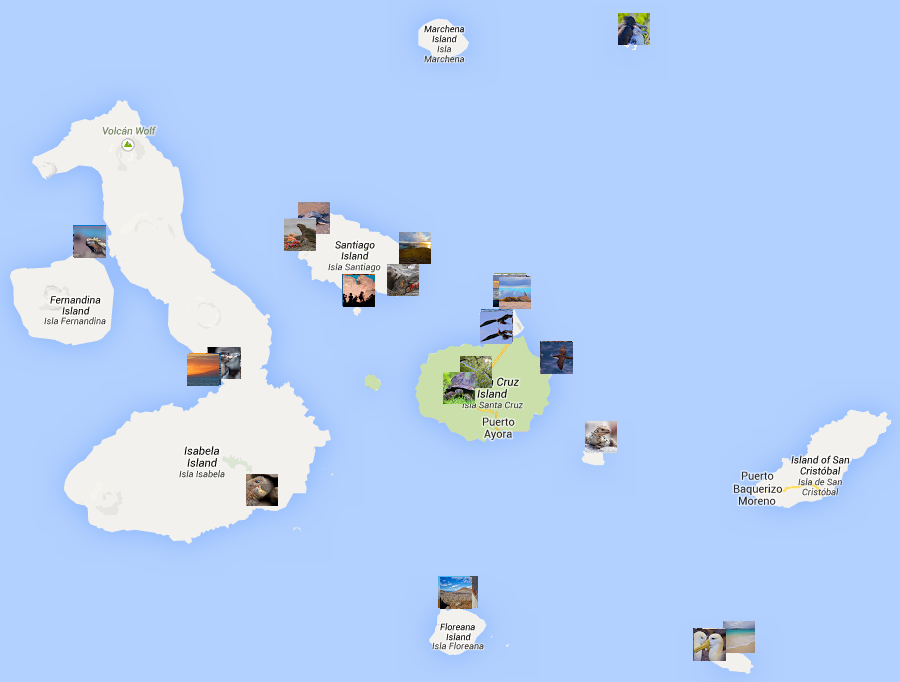
Click through below to see some photos geo-located on the map:
| Category | 2008 Trip | 2014 Trip
| DSLR | Canon 5D | Canon 6D
| Ultrawide lens | Canon 17-40mm f/4 | Canon 16-35mm f/4
| Long lens | Canon 100-400mm | Tamron 150-600mm
| Underwater | Canon G9 w/housing | Sony RX 100 w/housing
| Backup Camera | Canon G9 | Canon 7D
| Backup lenses | 24-105mm, 70-200mm f/4 | 24-70mm, 70-300mm L
| |
I used Canon full-frame cameras; if you use a different brand or sensor size you can translate most of my advice to your format. I carried backup for both me and my wife; if it is just you, you can take a chance with less backup. Here's a table of the percent of shots I took with each lenses on my 2014 trip, out of all shots in my library, and out of just my self-ranked "top" shots. The last column gives the percentage of top shots out of all shots taken with each lens (for example, 8% of the shots taken with the 150-600 were top, but only 3% of the shots taken underwater were top; I'm really bad at underwater shots).
| Lens | Type | All shots | Top shots | Top/All
| 16-35mm f/4 | ultrawide | 8% | 6% | 5%
| 24-70mm f/2.8 | wide | 5% | 4% | 5%
| 70-300mm L f/5.6 | long | 36% | 33% | 6%
| 150-600mm f/6.3 | long | 43% | 53% | 8%
| Sony RX 100 | underwater | 7% | 3% | 3%
| |
In 2014 I took about 800 shots a day, and when I had some down time, I would put them on my laptop, quickly scroll through, and delete about 3/4 of them, leaving about 200 per day. In 2008 I wasn't nearly as trigger-happy: I took about 250 a day and deleted about 2/3 of them. (I understand that some photographers have a policy of never deleting anything.)
The following table compares five choices. I give the lens, its maximum aperture, minimum focus distance, DxO Mark overall image quality score, retail price, and weight:
| Lens | f | MFD | DxO | Price | Weight
| Tamron 150-600mm | f/6.3 | 8 ft | 17 | $1,100 | 2.0 kg (4.3 lbs)
| Canon 100-400mm II | f/5.6 | 3 ft | 26 | $2,100 | 1.6 kg (3.5 lb)
| Canon 100-400mm I | f/5.6 | 6 ft | 16 | $1,300 | 1.4 kg (3.0 lbs)
| Canon 70-300 L | f/5.6 | 4 ft | 21 | $1,600 | 1.0 kg (2.3 lbs)
| Canon 70-200 f/2.8 II | f/2.8 | 4 ft | 27 | $2,500 | 1.5 kg (3.3 lbs)
| |
All of these lens are very good. If you have any one of these (or the equivalent in another camera system), don't worry, you will have a succesful trip to Galapagos. But if you are looking to buy or rent one of them, or choose between two that you already own, here are my thoughts in more detail:
Tamron 150-600mm: a new lens with reviews that rate it as slightly better image quality than the popular Canon 100-400mm (version I) at their common focal lengths. No other lens this light goes beyond 500mm. I used it in 2014 and found that it delivers on the promise. Image quality is very satisfactory. I found it was sharp enough, even at 500mm and beyond. I like the bokeh, compared to the 100-400mm, which I found more busy. The focal length range is great. I did find that not all images were sharp, compared to, say, the 200-400mm that I used in Botswana, where I could take just one shot and be confident it would be sharp. With the Tamron, I had to take 2 or 3 shots. Obviously the 200-400mm, which costs ten times as much, is a superior quality lens. But also, in Botswana the lens is solidly supported by a bean bag mounted on a stationary vehicle. In Galapagos I am hand-holding the lens, sometimes from a precarious position such as balancing on a rocking boat or trying not to cut myself on lava. So the real issue is not so much that the Tamron lens is poor at focusing or is soft beyond 500mm (as some reviews claim), but rather that focusing at 600mm without solid support is inherently very difficult—much more difficult than at 300mm. Another big consideration with this lens is the weight. If you're used to a kit zoom you will find this lens quite heavy. If you're used to a supertelephoto, you will find it quite light. For me, I had no problem at all carrying it from a shoulder sling strap and hand-holding it all day. The final consideration is the minimum focus distance of 8 feet, which is longer than the 4 or 6 feet that the other lens in this list get. For Galapagos this was not a big issue; for other uses a shorter MFD might be an important factor in choosing a lens. Some sample images from this lens, all at 600mm (you can click through for a bigger version, and you can mouse over for the shooting data):


Canon 100-400mm II: This lens was not yet released when I was in Galapagos. It improves image quality, build, stabilization, and minimum focus distance over the 100-400 I, and I think it would be the best choice for anyone who can afford it.
Canon 100-400mm I: has less range and perhaps slightly worse image quality than the 150-600mm (although I find the 100-400mm is sharp enough if you stop down to f/7.1 or f/8). George Lepp calls it his favorite wildlife lens, but others complain it is old, with outdated autofocus and image satbilization. I used this lens in 2008 and was mostly happy with it, but for me the 150-600mm was a better choice: a bit sharper, much longer range, and smoother bokeh. Samples from the 100-400mm I (also see Corey's album):


Canon 70-300mm L IS: faster focusing and higher optical quality than either the 100-400 I or the 150-600, and lighter, but of course it has a shorter reach. It would work very well with a crop-sensor camera (I was hoping the 7D II would be out before my trip, but I missed by a few months). In 2014 I carried the 70-300mm when I knew subjects would be close or large (like sea lions) or when we would be shooting from a crowded boat and I didn't want to be swinging a larger lens around. I carried the 150-600mm when I expected subjects would be small or farther away (e.g. ghost crabs).
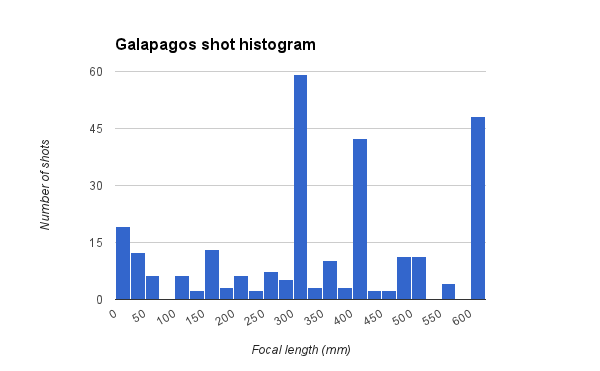
Could I have used the 70-300mm (or the 70-200 plus 1.4x) as my only long lens? Yes, but it would have meant changing my style and altering or foregoing the 53% of my shots that were longer than 300mm. What would I have done when I wanted to frame a 600mm shot, if I were only carrying a 300mm? Four choices: (1) Enjoy the scene with your eyes, not your camera. (2) Crop the shot: this can work if you don't want to print too large. If I crop to 1/4 of the frame, I end up with 5MP instead of 20MP; this should be fine for an 11x14 inch print, but probably not a 20x30 inch poster that will be viewed close up. (3) Walk forward to frame the subject: works well sometimes because animals are tame. Sometimes does not work, because you can't walk off the path, or because the behavior you want to capture is fleeting, or because you want a very tight angle to eliminate the background. (4) Switch to an environmental portrait rather than a close-up portrait: this means I have altered my intent, but the resulting picture might be as good or better as my originally intended one. Personally, I really like the close portrait style, so I like 400mm or 600mm lenses, but many people might have a style that doesn't need anything beyond 300mm.


Canon 70-200 f/2.8 L IS II: a superb lens in its focal range; the f/2.8 will give you beautiful subject isolation from the background. Also an excellent 100-280 f/4 when used with a teleconverter.
What about the gap between your wide and long lens? If you are bringing the 17-40mm and 70-300mm, don't worry about it. The 40-70mm gap is not worth filling with another lens; just take a few steps forward or back. If you are bringing the 16-35mm and 150-600mm then you might want to consider something in the 35-150mm gap (perhaps a 24-105mm or 70-200mm, or a quality compact or mirrorless camera).


The cactus shot is cropped very slightly; the marine iguana is a significant crop to about 20% of the frame (so although it is shot at 16mm, it is more like a 40mm field of view). You are not allowed to stick a camera right in an animal's face (National Park rules say everyone is supposed to keep a 2 meter radius away from animals, except for Americans, who are allowed 0.17 meters closer with only a six foot radius), so I couldn't get that shot at 16mm. However, you are allowed to sit in place and wait for a curious bird to approach your camera:


You can sometimes get a humorous effect with the right juxtaposition of foreground and background—forced perspective makes the juvenile frigate bird look like a giant, and the fuzzy white frigate bird chick looks goofy from any angle, but this one accentuates it:


Or you can just show that the animals are in an environment that includes people in close proximity:


Homo sapiens (and their cameras) have become part of the Galapagos environment; don't be afraid to feature them. The Galapagos Mockingbird posing for his closeup clearly does not understand the minimum focus distance of the 70-200mm:


Next try smaller, faster, but smooth flying birds like the swallowtail gull. I've used a shutter speed of 1/2000 sec to freeze any motion. Try to get an interesting background, like the rocks or sea below when shooting from a cliff, or at least an interesting cloud formation.


A real challenge: the small, fast, darting birds like the Tropic Bird (this one flew so close that I clipped a wing), and especially the Galapagos Shearwater:


The biggest challenge of all is getting the exact moment when a diving bird hits the water. This requires, skill, perseverance, and luck. Put the focus point on the bird as it circles. Then fire a burst of shots as it dives, trying to keep the focus point on the bird. The pelicans are larger and slower and thus easier than the blue-footed boobies.
Frame rate: The Canon 6D shoots at a rate of only 4.5 frames per second; for diving birds I found myself wanting a faster rate, like the 12 fps of the Canon 1D X (this was the only situation in Galapagos where I felt the 6D limited me in any way). Wikipedia says a booby can dive at 60 mph, which is 88 ft/sec. But most of the boobies and pelicans we saw started from relatively low heights and never reached such speeds; I would estimate (from studying successive frames) a range of 5 to 10 feet per frame (which is 22 to 45 ft/sec). With a 1D X or 7D II, that would be only 2 to 4 feet between frames. A pelican is 3 or 4 feet long, so I'd be almost guaranteed of seeing some part entering the water. But even at 4.5 fps, with enough repetition over many dives, I was able to get a half dozen really nice water-entry shots. Below are four examples; I won't show the many, many shots that were too early, too late, had the bird partially out of the frame (even in this "good" example the tip of the blue-footed booby's tail is out of the frame), or were completely out of focus.


On our trip Tui de Roy carried the Nikon 200-400mm f/4; Frans Lanting also recommends this lens. I've used the Canon version when I was sitting in a vehicle on safari, and it is a fantastic lens. But I agree with photographer Andy Williams, who says the 200-400mm is "way too ungainly to handle and use on the Islands in Galapagos." Tim Laman recommends that you and I carry one wide angle and one long lens (like the 100-400mm). But he says that he personally carries the 200-400mm. If I carried it, it would cover 80% of my shots, and would give me sharper, more contrasty images with smoother bokeh, faster focusing, and better image stabilization. But the lens is 8 lbs by itself, and you'll also need to bring a tripod, which is more weight, and you will lose time in transporting and setting up the tripod. To me: not worth it.
For the record, here are three choices in the supertelephoto category, compared to the four "non-super" lens discussed previously:
| Lens | f | MFD | DxO | Price | Weight | Note
| Canon 500mm f/4 II | f/4 | 12 ft | 25 | $10,000 | 3.2 kg (7 lbs)
| Canon 200-400mm f/4 | f/4 | 6.5 ft | 24 | $11,000 | 3.6 kg (8 lbs) | [f/5.6; DxO=17; 280-560mm with built-in 1.4x TC]
| Canon 300mm f/2.8 II | f/2.8 | 6.5 ft | 32 | $7,000 | 2.3 kg (5 lbs)
| Tamron 150-600mm | f/6.3 | 8 ft | 17 | $1,100 | 2.0 kg (4.3 lbs)
| Canon 100-400mm II | f/5.6 | 3 ft | 26 | $2,100 | 1.6 kg (3.5 lb)
| Canon 100-400mm I | f/5.6 | 6 ft | 16 | $1,300 | 1.4 kg (3.0 lbs)
| Canon 70-300 L | f/5.6 | 4 ft | 21 | $1,600 | 1.0 kg (2.3 lbs)
| |
We see that the supertelephotos cost 5 or 10 times as much, weigh around twice as much, and have image quality that is maybe 30% to 50% better. (Although I do not consider the DxO scores to be definitive. Consider that they give the same score, 17, to the Tamron 150-600 and the Canon 200-400 with the 1.4x teleconverter engaged. I know the 150-600. The 150-600 is a friend of mine. 150-600, you're no 200-400.) The only supertelephoto I would recommend for Galapagos is the 300mm f/2.8, because it is hand-holdable at "only" 5 lbs and of course has superb image quality, even with teleconverters. If I went again, I would take the 100-400 II, giving me supertelephoto image quality in a "regular" telephoto size and weight.
Renowned bird photographer Arthur Morris used the 400mm f/4 DO on his 2008 trip to Galapagos. He got great results as he always does, but he had to fuss with teleconverters and extension tubes. And he didn't have the 100-399mm range that I had. And he no longer had $6000. On his previous trip he lugged the 500mm f/4 and the 70-200 f/2.8 on separate cameras (and presumably a wide angle lens on a third camera). On his 2010 trip he took the 800mm; even heavier and more expensive, and in 2013 he used the 200-400mm along with other lenses, including the 600mm. It seems that Morris is so skilled and experienced with birds that he can make fantastic photos with just about any lens that is big and white and has an affiliate link.
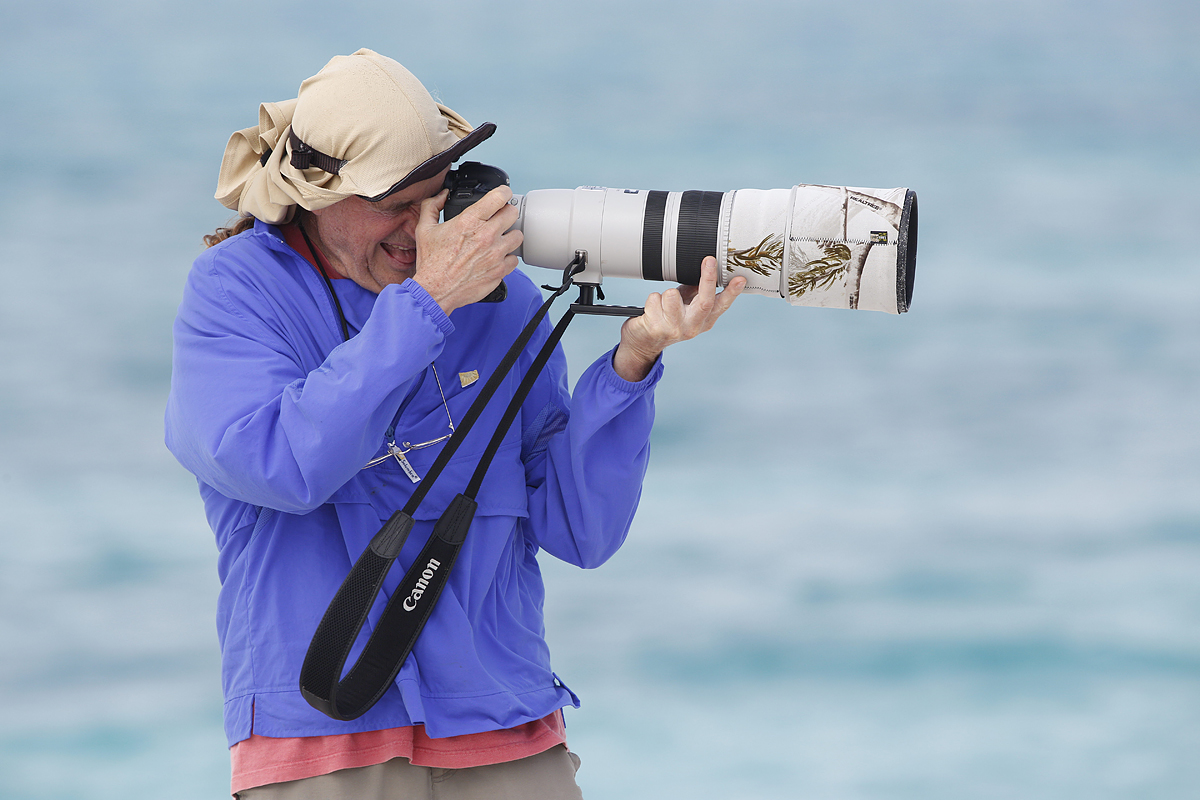
Judge for yourself: would you be comfortable shooting like Art Morris (left below) or Tim Laman (right)? Or would you prefer a lighter load?

-edited&sharpened-small.jpg)
You can also make panoramic landscape photos by stitching two or more images together. The first image below was stitched in Photoshop; someone more skilled than me could do a better job of balancing the light levels from left to right. The second was made in-camera with the Sony RX 100's panorama feature:


If you really want to use this trip as an excuse to upgrade (or to buy your first "good" camera), be my guest, but choose the new camera for your future shooting needs; there are no special demands on the camera made by Galapagos. If this is you, here are some options to consider:
Full-frame sensor DSLR: I chose full-frame (a 5D first trip, then a 6D). There are more options for wide-angle lenses. I didn't really need the high-ISO capabilities that full-frame offers in Galapagos, because you're not allowed on the islands when it is dark.
Crop sensor DSLR: I brought a 7D as a backup and used it a few times; I couldn't tell the difference in image quality between it and the 6D. A crop camera will work fine in Galapagos, and since crop cameras usually have greater pixel density, that will help for telephoto shots.
Mirorless system camera:I think a Sony or Fuji or micro-4/3 camera would be excellent for wide and medium range shots, but these systems historically have not had great long telephoto lenses, although in 2016 Olympus released a 300mm f/4 that might be perfect for locations like Galapagos. Two people on our trip did use mirrorless cameras and came away with strong portfolios (with more emphasis on wider shots).
Compact camera: Let's face it: if you've gitten this far reading this very nerdy guide, you're probably not the kind of person to bring only a non-interchangeable-lens compact camera. But a few readers are (I've heard from some), and maybe you have a friend or family member who is exactly that kind of person. They could do very well with one of the new 1" sensor compact cameras like the 24-200mm equivalent Sony RX10 or the 25-400mm equivalent Panasonic FZ-1000 or the Nikon DL 24-500 or the 24-600mm equivalent Canon G3X.
Second camera: Should you carry two cameras at all times, one with a long lens and one with a wide? Maybe. I wouldn't recommend carrying two cameras on straps though, because you don't want the second camera to dangle into the dirt or rocks when you are getting into low positions. Keep the second camera secure in a pack until you need it. A mirrorless camera with a wide-angle lens (such as an Olympus E-M1 with 7-14, 9-18, 12, or 12-40mm lens) would be an excellent light-weight and high-quality complement to a long lens on a DSLR. For me, I carried one camera and stopped to change lenses. I felt that I missed very few shots while changing lenses; maybe one every few days.
Should you have a backup camera back on the boat as insurance against equipment failure? Definitely! It would be best to have a second DSLR, but you might be satisfied with a compact or mirrorless camera for backup (perhaps one that you use for underwater). You should also have a backup strategy in case of lens failure. If you are travelling as a couple or group, you can share a backup between you.
I have two suggestions for underwater: first, shoot mostly video, not stills. Video is more forgiving of bubbles or particles in the water and of slightly blurred subjects. The GoPro is designed for video. Second, the most important thing for good underwater pictures is not the choice of camera, but the ability to dive down 5 to 15 feet and get your camera at the level of your subject. You typically wear a wetsuit in Galapagos which makes you buoyant, so to dive down, ask your tour operator ahead of time to stock a weight belt for you. Bring your own wetsuit or ask to rent one.


